Showing posts with label advertising. Show all posts

Thursday, August 11, 2011

Big deal or no?

Lots of blogging about Always' new ad campaign that actually portrays a red dot on one of their maxi pads, replacing the notorious/sanitized/confusing blue liquid.

image from adweek.com
Is this really that big of a deal?

Saturday, July 9, 2011

Can't quite put my finger on it...

I've been thinking of going to Florida lately.

Monday, May 23, 2011

Your body is disgusting. Let us help you out with that.

Libby Copeland at Slate has a really good article about how advertisers have historically marketed personal hygiene products--particularly new ones--by creating an anxiety for consumers and then oh-so-conveniently providing them the cure for it. This has long been effective marketing strategy for feminine hygiene products as well as deodorant.

Writes Copeland:

Dove recently unveiled its latest campaign, and it hinges on the idea that your armpits are ugly. Dove Ultimate Go Sleeveless is supposed to give women "softer, smoother underarms in just five days"—in ads for the product, which Stephen Colbert calls a "breakthrough shame-o-vation," women cut the sleeves off their tops with joyful expressions, as if they've been liberated from a terrible scourge. If it's news to you that this part of your body is not so hot, Dove says you're in the minority, citing a survey in which 93 percent of women said they "think their underarms are unattractive." And if you doubt statistics culled from 534 women in an anonymous online poll, rest assured that Dove's best advertising efforts will be directed at making those numbers true.
Pity the poor deodorant-makers. What else are they to do? As the Wall Street Journalpoints out, they're in a bind—almost the entire U.S. population already uses deodorant, and consumers appear reluctant to switch to new brands. Dove's empowerment-via-shame marketing approach for Go Sleeveless has its roots in advertising techniques that gained popularity in the 1920s: a) pinpoint a problem, perhaps one consumers didn't even know they had; b) exacerbate anxiety around the problem; c) sell the cure.
The history of ads directed at women is particularly rich with such fear tactics. Thus, ad copy from the 1920s and '30s warned women of their place in the "beauty contest of life" (a corset manufacturer) and reminded them that "The Eyes of Men …The Eyes of Women/ Judge your Loveliness every day" (Camay soap). A 1953 ad for Chlorodent toothpaste stated point-blank: "There's another woman waiting for every man." Yikes!
Certainly there's been a good dose of shame-marketing towards ladies' down theres, as Copeland explains. She highlights the use of Lysol as a douche.
The unfortunate truth was that as a contraceptive, Lysol was ineffective, not to mention dangerous. Improperly diluted, it burned and blistered the vagina, and in some cases even caused death. Yet, Tone writes, it wasn't until the pill came along that Lysol douche was supplanted as the top choice of women looking to prevent pregnancy.
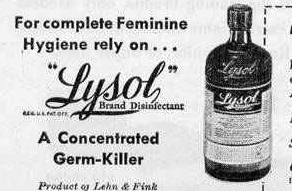

I've read about Lysol douching probably 100 times over the years, and I still cannot wrap my mind around the horribleness of the idea. I barely use any strong chemically-cleaning things, but sometimes I use Lysol to clean the bathroom. And when I do, I'm paranoid as shit. I super super dilute it, wear gloves, turn on the fans, and tell my cats to stay away so the fumes don't damage their sensitive little nosies. So the idea of using it to clean out the holiest of holies (so to speak) sounds just downright awful. (Although mentioning that this was the top birth control method before The Pill gives it some significant context.)

After reading this piece, I realized that all of the campaigns and products mentioned were marketed towards women. Surely similar tactics have been used to sell stuff to men as well, yes? I'd be interested to see how ad campaigns like this directed towards men differ from those direct towards women.

Thursday, April 28, 2011

What's the worth of natural disposable products?

I was cleaning out my desk space and found this ad that I meant to post about a long time ago--I wish I could remember in which magazine I found it. For some reason, I want to say Time, although this seems like a potentially bold ad for them. 
"Not cotton? My pads and tampons aren't 100% cotton? Introducing Organyc, the brand with the unsurpassed advantages of 100% cotton. It's surprising when you find out your tampons, pads and panty liners aren't 100% cotton. Introducing Organyc. No brand offers better natural absorbency than Organyc. And you get 100% organic and biodegradable cotton. What else would you want so close to you?"

Anyway, it's an advertisement from Organyc, which sells disposable pads/tampons/panty liners made out of 100% cotton. I like this ad because it's straight to the point, without any stupid euphemisms or talk about being free. I also like that it draws attention to the fact that "mainstream" brand products are in fact not made of cotton (they're a strange blend of plastic and low-grade wood pulp leftovers).

However, I've always had a bit of trouble getting behind organic disposable products. Sure, they are a better option than most other brands. The cotton biodegrades, meaning less trash in landfills, and I imagine they're more comfortable to wear. But the pads are also much more expensive than mainstream products, so they're only an option for buyers with higher incomes.

I looked around online to find out how much a pack of Organyc pads would cost. At target.com (not sure if they're available in the stores or just online), you can buy a case of four boxes for $19.99, a total of 40 pads. Each pad would cost about 50 cents each. When I compared this to data from the workshop I put together a few years ago, this is more than twice the cost of Always brand maxi pads (which where about 22 cents each).

However, I was surprised to find that the price of Organyc tampons is similar to the price of Playtex tampons. Four boxes of the tampons is also $19.99, which is a total of  64 tampons. Each tampon then is roughly about 31 cents, and again, comparing that to the data I used for my workshop, that's only about three cents more than buying Playtex tampons from Walgreens (at least in 2008).

But beyond cost, the thing that's never made complete sense to me about disposable natural products is the way they appeal to buyers' ecological awareness. It seems to me that someone who's in tune with helping the environment by reducing waste would be even more interested in reusable products such as the DivaCup which produce virtually no waste at all, so biodegradability or organic source materials kind of becomes a moot point. 

Anyone care to shed some light on this?

Sunday, January 30, 2011

The resurgence of Instead Softcups

Only in Bust magazine would an advertisement get right to the point like this:


It seems like I've seen a few ads for Softcups lately. I noticed that they've changed not only their name (marketing it more on Softcup than on Instead), but that the packaging also looks different from when I bought them three years ago. I'd still like to see them catch on.

Friday, December 3, 2010

Advertisting humor (?)

So, in my journeys I came across this website which has "funny" tampon ads from around the world.

I really like the painted ladies one, not for it's humor, but for the fact that those women are very artistically painted. The rest of them I only find mildly amusing, but you should definately look at the painted ladies.


Also, FYI I have finals next week, and thus you may not hear from this particular contributor.

May the Force Be With You.

Monday, November 15, 2010

Celebrity Endorsements Part 2: Aana Rae

Continuing with Celebrity Endorsements who I would buy tampons from:


The Women of DC Comics
These women are the epitomy of awesome. They literally were created to do nothing but kick butt and be bad ass. Especially my girl Wonder Woman. Wonder Woman (until recently) has been THE symbol for modern woman power.
Also, for those who aren't clear these ladies are from left to right: Catwoman, Oracle (sitting), Zatanna Zatara, Black Canary, Power Girl, Wonder Woman, Supergirl, Batwoman (sitting), Vixen, Poison Ivy, and Harley Quinn


Joan Jett
Because you almost cannot discuss strong bad-ass women without referencing awesome rocker Joan Jett. Joan Jett taught me that you don't have to "give a damn 'bout a bad reputation".


Nichelle Nichols
Because having the first on-screen television bi-racial kiss, as well as being FREAKING Uhura from Star Trek, makes her one of the most kicking women of all time. 


Sunday, November 14, 2010

Celebrity endorsements

Sometimes I like to think about how, in a perfect world, not only would commercial pads and tampons be safe and healthy for everyone, but they would also have awesome celebrity endorsements. I don't mean like from standard A-list celebrities like Julia Roberts or Taylor Swift--that sounds totally boring and predictable. I'm thinking of women that might make lady-bleeding seem tough and bad-assssssss.


My short list:


Samus is tough as shit. Super Metroid has been one of my all-time favorite games for quite a while, and when I found out Samus is actually a lady, it enhanced my fandom 10,000%. Wouldn't it be awesome to swim through lava acid and find a SuperPlus upgrade? (cue upgrade music-you can click number 16 here)

Here's even a picture of her on her day off I found on smosh.com. It made me feel more awesome about my gyno exam.


Xena


I don't even know that much about Xena, but she's obviously bad-ass. I know enough about her to know that I would wear pretty much any kind of tampon she might endorse.

Unless it was made of fire.


Lady Gaga

When she creates this kind of theatrical imagery on her own, do I really need to add much of an explanation?


Anyone you'd recommend?

Tuesday, September 7, 2010

A Date With Ryan

New campaign from Stayfree. It's slightly creepy, but also ridiculous enough to make me laugh.

Read better thought-out opinions and watch the other (quite similar) videos at The Globe and Mail.


design by suckmylolly.com